The flagship programme · for companies
Moja kwa Moja
One for one. And in Swahili, it also means directly. Both meanings are the whole idea.
Your customers buy what you sell. Each sale funds one published unit of good in Kenya, bought from a Kenyan supplier at a fixed, public price, and landed on a ledger anyone can check. Not a feeling. A receipt.
Pick a trigger. Pick a unit. Watch it land.
01
Per unit sold
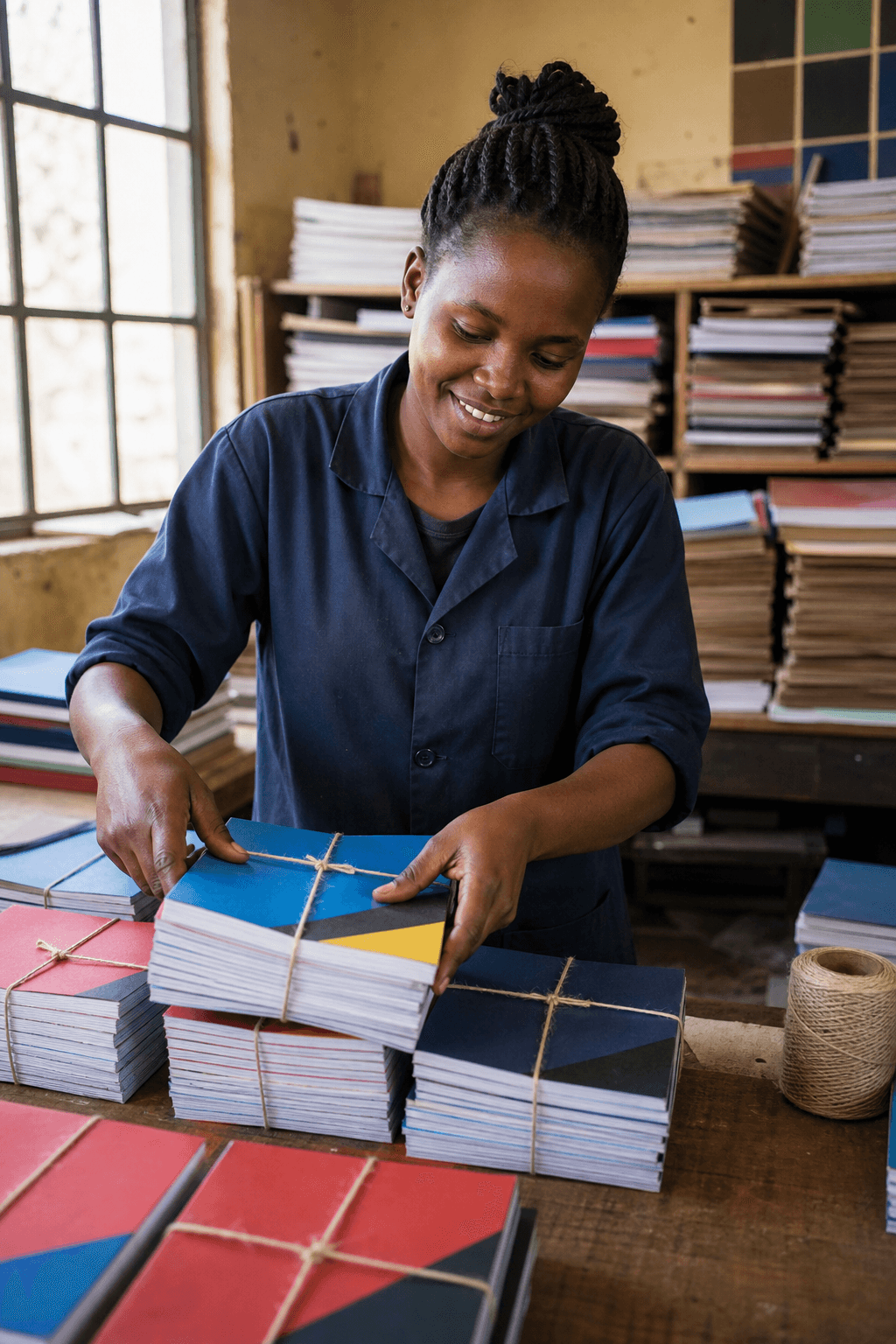
1 pair of shoes sold = 1 school book printed in Nairobi
Pick a product. Every sale funds one published unit. Your customers see the count grow on your site, and can follow any unit to its proof.
02
Percent of revenue
0.5% of revenue = water points that stay repaired
Assign a percentage. It lands monthly against the projects you chose, milestone by milestone, with every release on the ledger.
03
Per milestone
Every new client signed = 10 school lunches
Tie giving to the moments your business already celebrates: deals closed, invoices sent, targets hit. B2B firms with nothing to count per-unit start here.
The unit menu
Every unit has a fixed, published price and a named procurement route inside Kenya. Prices are planning figures, locked with suppliers at programme launch and then held stable for partners.
Unit
USD
KES
1 school book
Printed in Nairobi
$2.70
KES 350
1 school lunch
Sourced from county farmers
$0.55
KES 70
1 month of clean water for a family
County repair crews and maintenance fund
$3.80
KES 490
1 drought-resilient seed kit
Certified Kenyan suppliers via local agrovets
$9
KES 1,160
1 maternal health kit
Assembled from Kenyan suppliers
$12
KES 1,550
1 efficient cookstove
Fabricated in Kitui workshops
$16
KES 2,060
USD primary, KES at ≈129/USD. Unit definitions include verification method and re-check schedule.

Kitui County · jua kali workshop
Every unit funded is a Kenyan business paid.
Why we don't ship things to Kenya
Buy-one-give-one earned its bad name honestly. When donated goods are shipped in, research found local traders lose roughly one sale for every twenty items given away. The consumer feels generous; the local shoemaker loses a customer; nothing durable changes. The most famous one-for-one brand abandoned that model in 2021.
Moja kwa Moja is the corrected version. The give is never your product shipped across an ocean. It is a defined unit of good, procured in Kenya, from Kenyan businesses, priced publicly and verified independently. A shoe sold in London funds a book printed in Nairobi: two economies win, and neither is undercut.
If a proposed unit would compete with local traders, it does not go on the menu. That rule is absolute.
Proof your customers can audit
Partners get an embeddable widget for their own site: a live count of units funded, each one clickable through to its ledger record and field verification. It is marketing collateral that survives due diligence, because it is not marketing. It is the ledger.
Design your programme with usyourbrand.com · impact widget
Illustrative demo · not real transactions12,847
school books printed in Nairobi, funded by your purchases
Latest unit#12,847 · verified · Kajiado
Ledger referenceLHF-0185 → uwazi.loveheartfoundation.com
Independent re-checkdue 2028-03